Showing posts with label Nature. Show all posts

Tuesday, November 3, 2015

Purposeful Living with Miss ECO Sierra Leone 2016

When you drop any new idea in the pond of the world, you get a ripple effect. You have to be aware that you will be creating a cascade of change. Joel A. Barker.
Live a life with purpose.
Miss ECO Sierra Leone 2016 Ruby B. Johnson

Miss ECO Sierra Leone 2016 Cleans Up

Gree(n)tings everyone!!!

I hope you and yours are doing well. I've been doing great, all thanks to my Lord and Savior Jesus Christ. On October 17th, I picked up trash and bottles to be recycled. Planet earth is our home in this lifetime, we need to keep it clean.
Miss ECO Sierra Leone 2016 Ruby B. Johnson
Be environmentally responsible in your home and community. We must incorporate eco-friendly practices in our lifestyle.
Miss ECO Sierra Leone 2016 Ruby B. Johnson

Ruby B. Johnson,
Your Miss Eco Sierra Leone 2016,
Salone's Eco Queen.

Thursday, September 10, 2015

Ruby B. Johnson crowned Miss Eco Sierra Leone 2016

On August 30, 2015 His Excellency Hon. Bockarie Stevens, Sierra Leone’s Ambassador to the U.S., crowned Miss Earth Maryland 2015 Ruby B. Johnson as Miss Eco Sierra Leone. Ruby will serve as Sierra Leone’s official delegate at the prestigious 2016 Miss ECO Pageant in Egypt.

Ruby accepted her new title to the applause of a select group of influential leaders within the Sierra Leonean Diaspora community gathered at the Embassy of Sierra Leone that included: Dr. Fuambai Sia Ahmadu, Founder and Owner of the Miss Sierra Leone USA Pageant; Mr. David Vandy of Voice of America; Mr. Daniel Koroma of the Montgomery County Executive Office and Ms. Ramzhain Suma, former Miss Sierra Leone Heritage.

As Miss ECO Sierra Leone, Ruby will promote ecotourism, green economy, and environmental awareness. She will devote her year advocating about environmental issues in Sierra Leone and worldwide.


Salone Tourism Thursday - Geography of Sierra Leone


Follow my adventures as Miss ECO Sierra Leone on Facebook, Twitter, and Instagram.

Tuesday, July 14, 2015

9 days till Miss Earth United States 2015 Pageant

Gree(n)tings everyone!!!

I hope you and yours are doing well. I'm doing well, thanks be to God! I can't believe that in 9 days Miss Earth United States 2015 pageant weekend officially commences. I have truly enjoyed this journey as Miss Earth Maryland 2015 and serving my Blue Crab state. The preparation for the job of Miss Earth United States and the national pageant has enhanced my skills as well as pushed me out of my comfort zone in many ways. This is one of the reasons why I love the Miss Earth system because it empowers women to be well-rounded in embracing womanhood, being compassionate, and as well as champions for our environment. I am a woman of the earth! If you'll like to follow my preparation and journey, follow me on Facebook, Twitter, or Instagram. The hashtag on all social media is #MDforMEUS
Miss Earth Maryland 2015 Ruby B. Johnson
Official Headshot for Miss Earth United States Pageant
Photo by Prince Zamira Photography
Miss Earth Maryland 2015 Ruby B. Johnson
I am a firm believer that it takes a village to create a phenomenal woman and man. Therefore, I am so grateful for those in and outside of my circle who have been influential in my life, and those I have crossed paths with in various ways. I am thankful for my blessings and lessons in this journey thus far. I am grateful to my sponsors: mom, dad, family, and friends; Dr. Fuambai Sia Ahmadu (CEO of Miss Sierra Leone USA Leadership Pageant); Prince Zamira Photography; and FO Fitness. Additionally, I am so grateful for my pageant mentor, Ms. Bonnie, for polishing my talents and challenging me to be the best Ruby I can be. In the time leading towards the national pageant, I have been getting ready dilligently so I can be the full package in representing my Old Line State and being the best of myself. I am ready for the job as Miss Earth United States.
Miss Earth Maryland 2015 Ruby B. Johnson
What I love about Miss Earth is its unique mission of advocating for the preservation of our environment; among the many international pageants, it is the only pageant that advocates for a cause like this and gives women a platform to be "Beauties for a Cause." Having received my undergraduate degree in mining engineering from Virginia Tech, my field of interest directly impacts the earth. Therefore, I am using this platform as a Miss Earth titleholder to advocate for my passion of mining but also promote and cultivate ways that the industry moves towards a sustainable future. It is possible for an individual to support the mining industry but also care about the environment. Hence the reason my platform is "Bridging The Gap: Miners and Environmentalists Must Work Together for Mother Earth!" I am looking forward to sharing this platform with everyone at nationals, and nationwide as Miss Earth United States 2015.
Miss Earth Maryland 2015 Ruby B. Johnson
The three great elemental sounds in nature are the sound of rain, the sound of wind in a primeval wood, and the sound of outer ocean on a beach. - American writer and naturalist Henry Beston.


Ruby B. Johnson,
Your Miss Earth Maryland 2015
Continuing the legacy of beauty and responsibility
Help me compete at Miss Earth United States 2015. DONATE HERE

Monday, June 8, 2015

Miss Earth Maryland Celebrates World Oceans Day 2015

Gree(n)tings everyone!!!

I hope you and yours are doing well. I've been busy but blessed, all thanks to the Almighty. Today, June 8, is World Oceans Day. The theme for this year is "Healthy Oceans, Healthy Planet." WOD is the United Nations-recognized day of ocean celebration and action, to support action to protect the ocean.
Miss Earth Maryland 2015 Ruby B. Johnson
We are all linked to the ocean. Even if you live inland, your actions and behaviors can impact the oceans and its resources. Trash and pollutants are carried out to sea from land via rivers, streams, and the wind. Both inlanders and coastal residents can make small changes in their everyday lives to help conserve the ocean. One simple change is to avoid using disposable plastic bags. More than 8 million tons of plastic trash, including millions of disposable plastic bags, litter the ocean every year. Packaging store purchases in reusable bags will reduce trash in our oceans and help save the lives of sea turtles, whales, dolphins, seabirds, and other wildlife who call the ocean their home.
Miss Earth Maryland 2015 Ruby B. Johnson

Five Ways To Protect Our Oceans

[1] Eat Sustainably-Caught Seafood
By doing this, you will protect the health of the fish populations and protect coral reefs. Use the Ocean Wise Guide before you shop with your family.

[2] Grow/Buy Organic
You will protect coral reefs and limit dead zones. This farming/gardening method doesn’t use chemicals or dangerous fertilizers. Plant an organic garden. Buy and eat organic food. Check for organic certification labels and the PLU number that starts with “9.”

[3] Make Less Waste
You will decrease marine litter and protect coral reefs. Buy items with less packaging. Stop using disposable containers. Buy milk in recyclable cartons, not in plastic bags. Pack litter-free lunches. Use cloth bags or metal containers.
[4] Stop Using Plastic
You will decrease marine litter. Replace the plastic things in your life with other materials like glass, wood, or metal. Use biodegradable plastics made from plants (corn). Recycle ALL plastic. Properly sort all garbage and recycling. Have plastic-free picnics!

[5] Reduce Your Carbon Footprint.
You will limit dead zones and protect coral reefs.

[BONUS] Use Organic Sunscreen
Additionally, use sunscreen with safe ingredients. You will protect coral reefs. It’s better for your body AND the ocean!
Miss Earth Maryland 2015 Ruby B. Johnson


Ruby B. Johnson,
Your Miss Earth Maryland 2015
Continuing the legacy of beauty and responsibility
Help me compete at Miss Earth United States 2015. DONATE HERE


Sources: 

Thursday, June 4, 2015

Miss Earth Maryland Celebrates World Environment Day 2015

Gree(n)tings everyone!!!

I hope you and yours are doing well. I'm doing great, all thanks to the Almighty. Today, June 5th, is a very special day because it is World Environment Day! This year's theme is "Seven Billion Dreams. One Planet. Consume with Care." WED is the opportunity for everyone to realize the responsibility to care for the Earth and to become agents of change.
Miss Earth Maryland 2015 Ruby B. Johnson
Photo by ROS Productions
Fact: World Environment Day (WED) is the United Nations’ principal vehicle for encouraging worldwide awareness and action for the environment. Over the years it has grown to be a broad, global platform for public outreach that is widely celebrated by stakeholders in over 100 countries. It also serves as the ‘people’s day’ for doing something positive for the environment, galvanizing individual actions into a collective power that generates an exponential positive impact on the planet.
Purpose of 2015 Theme: Living within planetary boundaries is the most promising strategy for ensuring a healthy future. Human prosperity need not cost the earth. Living sustainably is about doing more and better with less. It is about knowing that rising rates of natural resource use and the environmental impacts that occur are not a necessary by-product of economic growth.


EVERY DAY IS WORLD ENVIRONMENT DAY!


Ruby B. Johnson,
Your Miss Earth Maryland 2015
Continuing the legacy of beauty and responsibility
Help me compete at Miss Earth United States 2015. DONATE HERE

Source:

Tuesday, June 2, 2015

My Green Maryland - 5 Things To Know About The Patuxent River

Gree(n)tings everyone!!!

I hope you and yours are doing well. I'm doing well, thanks to the Almighty! For today's "My Green Maryland," I'll be sharing interesting things about Maryland's own Patuxent River. The Patuxent River is a tributary of the Chesapeake Bay in the state of Maryland. There are three main river drainages for central Maryland: the Potomac River to the west passing through Washington D.C., the Patapsco River to the northeast passing through Baltimore, and the Patuxent River between the two.
Miss Earth Maryland 2015 Ruby B. Johnson
Photo by ROS Productions

[1] Size
The 937-square-mile Patuxent watershed had a rapidly growing population of 590,769 in 2000. It is the largest and longest river entirely within Maryland, and its watershed is the largest completely within the state.

[2] County Boundaries
The Patuxent River marks the boundary between Montgomery, Prince George's, Charles and St. Mary's counties on the west and Howard, Anne Arundel, and Calvert counties on the east. The Chesapeake estuary's deepest point, 130 feet below sea level, is in the lower Patuxent.

[3] The Three Tributaries
The Little Patuxent River, the Middle Patuxent River, and the Western Branch are the three largest tributaries. The Middle Patuxent flows into the Little Patuxent just upstream from the historic Savage Mill in Savage. The Little Patuxent then joins the Patuxent just southwest of Crofton. The Middle Patuxent flows 24 miles (39 km) through the middle of Howard County, while the Little Patuxent flows 38 miles (61 km) through northeast and southeast Howard County and western Anne Arundel County.

Governor's Bridge over Patuxent River near Bowie, Maryland

[4] Pauxent River State Park
Patuxent River State Park is located in Howard and Montgomery counties, along the upper 12 miles of the Patuxent River. The park is comprised of 6,700 acres of natural areas and farmlands. Recreational use is primarily hunting, fishing, hiking and horseback riding. A portion of the park is a state wildlands area.

[5] NAS Pax River
The Patuxent Naval Air Station at the mouth of the river has continued to grow over past decades, providing along with tourism another main economic engine in the lower river valley which includes the popular boating center of Solomons.

[Bonus] History and Commerce
Tobacco farming dominated the Patuxent's economy for the two centuries following settlement, with about sixty percent of Maryland's tobacco coming from the Patuxent valley by the late 18th century.


Ruby B. Johnson,
Your Miss Earth Maryland 2015
Continuing the legacy of beauty and responsibility
Help me compete at Miss Earth United States 2015. DONATE HERE

Thursday, April 23, 2015

Miss Earth Maryland Presents...Earth Month 2015 (Week 3)

Gree(n)tings everyone!!!

I hope you and yours are doing well. I am doing great, thanks be to God! As some of you may know, April commemorates Earth Month! If you are connected with me on Facebook, you will have noticed that every day in the month so far, I've posted interesting tidbits about planet Earth in my Thank You, Mother Earth series. Below is a summary of Earth Month 2015, Week 3:

Day 15: Granite

Granite is a felsic intrusive igneous rock and has been used as a building material for many centuries. The granite mineral composition is composed primarily of quartz, mica and feldspar as well as other minerals. Granites can be predominantly white, pink, or gray in color, depending on their mineralogy. Granite is blasted from quarries in large blocks and then sliced like a loaf of bread to create bundles. The granite slabs in that bundle will match and mimic each other in directionality and color variation. Most slabs are rarely longer than 10 feet long. Granite has tiny pits or spaces between the various mineral crystals. This is caused primarily by Biotite. The extrusive igneous rock equivalent of granite is rhyolite.

Day 16: Potash

Potash is any of various mined and manufactured salts that contain potassium in water-soluble form. The name derives from "pot ash", which refers to plant ashes soaked in water in a pot, the primary means of manufacturing the product before the industrial era. The word "potassium" is derived from potash. Today, potash is produced worldwide at amounts exceeding 30 million tonnes per year, mostly for use in fertilizers. Various types of fertilizer-potash thus constitute the single largest global industrial use of the element potassium. Potassium was first derived by electrolysis of caustic potash (potassium hydroxide), in 1808.

Day 17: Bauxite

Bauxite, an aluminium ore, is the world's main source of aluminium. It consists mostly of the minerals gibbsite, boehmite and diaspore, mixed with the two iron oxides goethite and haematite, the clay mineral kaolinite and small amounts of anatase. Lateritic bauxites (silicate bauxites) are distinguished from karst bauxite ores (carbonate bauxites). The carbonate bauxites occur predominantly in Europe and Jamaica above carbonate rocks (limestone and dolomite); lateritic bauxites are found mostly in the countries of the tropics. Bauxite is usually strip mined because it is almost always found near the surface of the terrain, with little or no overburden. Bauxite rocks are typically classified according to their intended commercial application: metallurgical, abrasive, cement, chemical, and refractory. Increased aluminium recycling, which has the advantage of lowering the cost in electric power in producing aluminium, will considerably extend the world's bauxite reserves.

Day 18: Platinum

Platinum is a soft, dense, ductile metal that is very resistant to corrosion. It is used to make jewelry, wire, electrical contacts and laboratory vessels. Platinum expands at nearly the same rate as soda-lime-silica glass, so it is used to make sealed electrodes in glass systems. Platinum is used to coat missile nose cones, jet engine fuel nozzles and other devices that must operate reliably for long periods of time at high temperatures. Platinum resistance wires are used in high temperature electric furnaces. Platinum anodes are used in cathodic protection systems to prevent ships, pipelines and steel piers from corroding in salt water.

Day 19: Boron

Boron is a vital trace mineral that is required for the normal growth and health of the body. Many dangerous conditions like arthritis and osteoporosis are naturally managed by Boron, and it helps to reduce menopausal symptoms as well. It is believed that boron improves the natural ability of the human body to absorb calcium and magnesium. Boron is able to enhance the testosterone levels in males; this quality is increasingly taken advantage of by male body builders and athletes. Boron neutron capture agents are used for cancer therapy and in the development of strong enzyme inhibitors. Boron can significantly alleviate the difficulties caused by congestive heart failure conditions.


Day 20: Graphite

Graphite is a soft, crystalline form of carbon. Other forms are diamond and fullerenes ("buckyballs"). It is gray to black, opaque, and has a metallic luster. It is flexible but not elastic. Graphite occurs naturally in metamorphic rocks such as marble, schist, and gneiss. It exhibits the properties of a metal and a nonmetal, which make it suitable for many industrial applications. The metallic properties include thermal and electrical conductivity. The nonmetallic properties include inertness, high thermal resistance, and lubricity. Some of the major end uses of graphite are in high-temperature lubricants, brushes for electrical motors, friction materials, and battery and fuel cells. 

Day 21: Halite
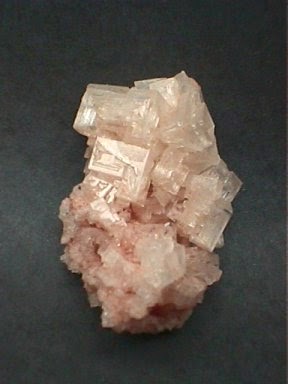
Halite, the natural form of salt, is a mineral found in solid masses, and as a dissolved solution in the oceans and in salt lakes. The inland lakes that are rich in salt exist in arid regions, and may also be below sea level without an outlet. Many of these inland lakes have already dried up, leaving over enormous salt deposits which may be commercially mined. Halite also exists in non-arid regions, in underground deposits which can reach great depths. Underground Halite deposits are often mined by drilling wells into the salt layer, and bringing in hot water which quickly dissolves the salt into a brine. The brine is saturated with dissolved salt and is then pumped out. The brine evaporates and the remainder salt crystallizes and is harvested. In some underground salt deposits such as Texas and Louisiana, salt is pushed upwards by an underground force through soft ground and forms arched structures known as salt domes. These deposits are also important sources of salt mining operations and are very unique geological formations. Halite can be used for food, and deicing snow roads during winter season.


Ruby B. Johnson,
Your Miss Earth Maryland 2015
Continuing the legacy of beauty and responsibility
Help me compete at Miss Earth United States 2015. DONATE HERE
Ruby B. Johnson
Seeking Sponsors for Miss Earth United States 2015

Tuesday, April 21, 2015

Miss Earth Maryland Celebrates Earth Day 2015

Gree(n)tings everyone!!!

I hope you and yours are doing well. I've been blessed, thanks be to God! It's EARTH DAY! Earth Day is celebrated on April 22nd with events worldwide held to demonstrate support for environmental protection. It was first celebrated in 1970, and is now coordinated globally by the Earth Day Network, and celebrated in more than 192 countries each year.
Miss Earth Maryland Ruby B. Johnson
Earth Day 2015
FACT: In 2007, Forbes.com rated Maryland as the 5th "Greenest" state in the United States behind 3 of the Pacific States and Vermont. Maryland ranks 40th in total energy consumption nationwide, and it managed less toxic waste per capita than all but 6 states in 2005. In April 2007 Maryland joined the Regional Greenhouse Gas Initiative (RGGI) - a regional initiative formed by all of the Northeastern states, Washington D.C., and 3 Canadian provinces to reduce greenhouse gas emissions.
Miss Earth Maryland Ruby B. Johnson
Earth Day 2015
FACT: The United States Environmental Protection Agency (EPA or sometimes USEPA) is an agency of the U.S. federal government which was created for the purpose of protecting human health and the environment by writing and enforcing regulations based on laws passed by Congress. The agency is led by its Administrator, who is appointed by the president and approved by Congress. The current administrator is Gina McCarthy.The agency conducts environmental assessment, research, and education. It has the responsibility of maintaining and enforcing national standards under a variety of environmental laws, in consultation with state, tribal, and local governments. It delegates some permitting, monitoring, and enforcement responsibility to U.S. states and the federally recognized tribes.
Miss Earth Maryland Ruby B. Johnson
Earth Day 2015
FACT: Miss Earth United States is the official preliminary competition that sends US delegates to the Miss Earth pageant. Miss Earth is an annual international pageant promoting environmental awareness. The Miss Earth winner is the spokesperson for the Miss Earth Foundation, the United Nations Environment Programme (UNEP) and other environmental organizations. The Miss Earth Foundation also works with the environmental departments and ministries of participating countries, various private sectors and corporations, as well as Greenpeace and the World Wildlife Foundation (WWF).
Miss Earth Maryland Ruby B. Johnson
Earth Day 2015


Ruby B. Johnson,
Your Miss Earth Maryland 2015
Continuing the legacy of beauty and responsibility
Help me compete at Miss Earth United States 2015. DONATE HERE

Wednesday, April 15, 2015

Miss Earth Maryland Presents...Earth Month 2015 (Week 2)

Gree(n)tings everyone!!!

I hope you and yours are doing well. I am doing great, thanks be to God! As some of you may know, April commemorates Earth Month! If you are connected with me on Facebook, you will have noticed that every day in the month so far, I've posted interesting tidbits about planet Earth in my Thank You, Mother Earth series. Below is a summary of Earth Month 2015, Week 2:

Day 8: Brown
Miss Earth Maryland 2015 Ruby B. Johnson

The thin top layer of the earth's crust on land is largely made up of soil colored different shades of brown. Good soil is composed of about 45% minerals, 25% water, 25% air, and 5% organic material, living and dead. Half the color of soil comes from minerals it contains; soils containing iron turn yellowish or reddish as the iron oxidizes. Manganese, nitrogen and sulfur turn brownish or blackish as they decay naturally. Rich and fertile soils tend to be darker in color; the deeper brown color of fertile soil comes from the decomposing of the organic matter. Dead leaves and roots become black or brown as they decay. Poorer soils are usually paler brown in color, and contain less water or organic matter.

Day 9: Snow
Miss Earth Maryland 2015 Ruby B. Johnson

Snow is precipitation in the form of flakes of crystalline water ice that falls from clouds. A granular material. It has an open and soft, white, and fluffy structure, unless subjected to external pressure. Snowfall can be beneficial to agriculture by serving as a thermal insulator, conserving the heat of the Earth and protecting crops from subfreezing weather. Some agricultural areas depend on an accumulation of snow during winter that will melt gradually in spring, providing water for crop growth. If it melts into water and refreezes upon sensitive crops, such as oranges, the resulting ice will protect the fruit from exposure to lower temperatures.

Day 10: Spring
Miss Earth Maryland 2015 Ruby B. Johnson

Spring is one of the four conventional temperate seasons, following winter and preceding summer. Spring and "springtime" refer to the season, and also to ideas of rebirth, rejuvenation, renewal, resurrection and regrowth. During spring, the hemisphere begins to warm significantly causing new plant growth to "spring forth," and many flowering plants bloom this time of the year. The rainfall in spring follows trends more related to longer cycles or events created by ocean currents and ocean temperatures.

Day 11: Leaves
Miss Earth Maryland 2015 Ruby B. Johnson

Leaves are the food making factories of green plants. Leaves come in many different shapes and sizes. Leaves in temperate, boreal, and seasonally dry zones may be seasonally falling off or dying for the inclement season. This mechanism to shed leaves is called abscission. When the leaf is shed, it leaves a leaf scar on the twig. In cold autumns, they sometimes change color, and turn yellow, bright-orange, or red, as various accessory pigments (carotenoids and xanthophylls) are revealed when the tree responds to cold and reduced sunlight by curtailing chlorophyll production.

Day 12: Sustainability
Miss Earth Maryland 2015 Ruby B. Johnson

Sustainability is based on a simple principle: Everything that we need for our survival and well-being depends, either directly or indirectly, on our natural environment. Sustainability creates and maintains the conditions under which humans and nature can exist in productive harmony, that permit fulfilling the social, economic and other requirements of present and future generations. Sustainability is important to making sure that we have and will continue to have, the water, materials, and resources to protect human health and our environment.

Day 13: Pine Needles
Miss Earth Maryland 2015 Ruby B. Johnson

Pine needle mulch is an organic material that is readily available at garden centers and nurseries. Like any mulch, pine needles provide protection for roots and help preserve moisture in the soil. Pine needles, a renewable resource, drop annually from trees and the pine straw is bundled into either round or square bales for sale. 3 cubic feet of pine straw covers 60 square feet at a depth of 2 to 3 inches. As pine needles decompose, they add acid to the soil. Marigolds, snapdragons, zinnias, dahlias and roses are just a few flowers that grow well in pine needle mulch. Blueberries, onions, potatoes, strawberries and tomatoes are a sample of the plants that produce edibles that do well in gardens mulched with pine straw.

Day 14: Ruby
Ruby stone
A ruby is a pink to blood-red colored gemstone, a variety of the mineral corundum (aluminium oxide). The red color is caused mainly by the presence of the element chromium. Its name comes from ruber, Latin for red. Other varieties of gem-quality corundum are called sapphires. Ruby is considered one of the four precious stones, together with sapphire, emerald and diamond. Ruby stones are stones of love, passion, vitality and power. Its main chakra is the heart and has the astrological sign of Leo, Scorpio, Cancer and Sagittarius. It is the July birthstone.


Ruby B. Johnson,
Your Miss Earth Maryland 2015
Continuing the legacy of beauty and responsibility
Help me compete at Miss Earth United States 2015. DONATE HERE

Tuesday, April 7, 2015

Miss Earth Maryland Presents...Earth Month 2015 (Week 1)

Gree(n)tings everyone!!!

I hope you and yours are doing well. I am doing great, thanks be to God! As some of you may know, April commemorates Earth Month! If you are connected with me on Facebook, you will have noticed that every day in the month so far, I've posted interesting tidbits about planet Earth in my Thank You, Mother Earth series. Below is a summary of Earth Month 2015, Week 1:

Day 1: Recycling
Miss Earth Maryland 2015 Ruby B. Johnson
Recycling is a process to change waste materials into new products to prevent waste of potentially useful materials, reduce the consumption of fresh raw materials, reduce energy usage, reduce air pollution and water pollution by reducing the need for "conventional" waste disposal. Recycling is a key component of modern waste reduction and is the third component of the "Reduce, Reuse and Recycle" waste hierarchy. Recyclable materials include many kinds of glass, paper, metal, plastic, textiles, and electronics. The composting or other reuse of biodegradable waste (food or garden waste) is also considered recycling.

Day 2: Green
Miss Earth Maryland 2015 Ruby B. Johnson
Green is the symbolic color of environmentalism and sustainability. In many cultures, green is the color associated with nature and growth. Anything can be green—from energy policy to building design, parenting techniques, and economic strategies. Green is often used to describe efforts to reduce the impact of modern human life on the rest of the natural world.

Day 3: Beach
Miss Earth Maryland 2015 Ruby B. Johnson
A beach is a landform along the coast of an ocean, sea, lake, or river. It usually consists of loose particles, which are often composed of rock, such as sand, gravel, shingle, pebbles, or cobblestones. The particles comprising a beach are occasionally biological in origin. Some beaches have man-made infrastructure, such as lifeguard posts, changing rooms, and showers. Wild beaches, also known as undeveloped or undiscovered beaches, can be valued for their untouched beauty and preserved nature. Beaches typically occur in areas along the coast where wave or current action deposits and reworks sediments.

Day 4: Tree Branch
Miss Earth Maryland 2015 Ruby B. Johnson
A tree branch (sometimes referred to in botany as a ramus) is a woody structural member connected to but not part of the central trunk of a tree (or sometimes a shrub). Large branches are known as boughs and small branches are known as twigs. While branches can be nearly horizontal, vertical, or diagonal, the majority of trees have upwardly diagonal branches. Twig often refers to a terminus, while bough refers only to branches coming directly from the trunk. While branches can be nearly horizontal, vertical, or diagonal, the majority of trees have upwardly diagonal branches.

Day 5: National Forests
Miss Earth Maryland 2015 Ruby B. Johnson
National Forest is a classification of federal lands in the United States. National Forests are largely forest and woodland areas owned collectively by the American people through the federal government and managed by the United States Forest Service, part of the United States Department of Agriculture. Land management of these areas focuses on conservation, timber harvesting, livestock grazing, watershed protection, wildlife, and recreation. Unlike national parks and other federal lands managed by the National Park Service, extraction of natural resources from national forests is permitted, and in many cases encouraged. National Forests are categorized by the World Commission on Protected Areas as IUCN Category VI (Managed Resource Protected Area).

Day 6: Plants
Miss Earth Maryland 2015 Ruby B. Johnson
Plants bring natural beauty to our living spaces. By creating texture and balance, a room or patio can be transformed into an environment that comforts and welcomes. In addition to calming your heart rate, plants lower blood pressure and reduce muscle tension related to stress. Plants help us relax and focus, leading to increased productivity, creativity, idea generation, and problem-solving capabilities. The presence of plants helps to relieve the symptoms experienced by children with ADD. Additionally, plants help patients recovering from surgery and ease the symptoms of Alzheimer’s.

Day 7: Pond
Miss Earth Maryland 2015 Ruby B. Johnson
A pond is a body of standing water, either natural or artificial, that is usually smaller than a lake. They may arise naturally in floodplains as part of a river system, or they may be somewhat isolated depressions. Usually they contain shallow water with marsh and aquatic plants and animals. A few animals also make their home in ponds, including both alligators and beavers. The type of life in a pond is generally determined by a combination of factors including water level regime (particularly depth and duration of flooding) and nutrient levels, but other factors may also be important, including presence or absence of shading by trees, presence or absence of streams, effects of grazing animals, and salinity.


Ruby B. Johnson,
Your Miss Earth Maryland 2015
Continuing the legacy of beauty and responsibility
Help me compete at Miss Earth United States 2015. DONATE HERE